
Drain Cleaning
Clearing the line is step one — and the test of whether the pipe itself is sound enough to stay cleared.
Sewer Line Repair — Pocatello, ID
Backups that keep coming back, roots in the line, cracked clay pipe — diagnosed on camera first, then repaired or replaced by independent local plumbers.
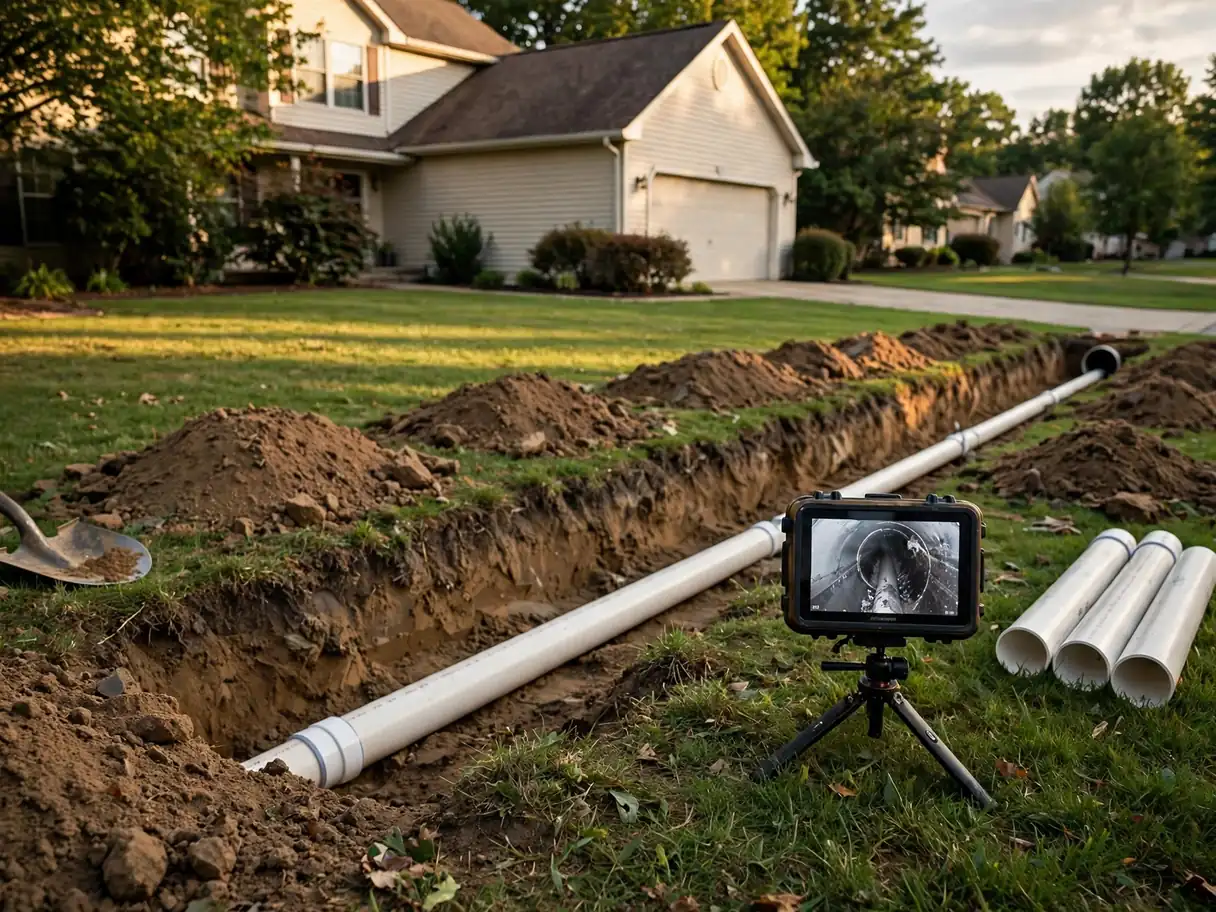
Every sewer line repair worth doing starts the same way: with a camera in the line. A sewer lateral is buried, invisible, and expensive to dig up on a guess — so the plumbers we connect you with run a waterproof camera from the cleanout and show you the inside of your own pipe on a monitor. Roots massed at a joint. A crack with soil washing in. A sagging belly holding water and solids. An offset where two sections of old clay pipe have shifted apart. Each problem has a different fix and a different price, and the footage is what tells them apart.
Pocatello's ground makes this a common job. Much of the city was plumbed when clay and cast iron were the standard, and those lines are now fifty to eighty years old. Clay joints open as soil settles, and roots from the big shade trees in Old Town and Alameda find every opening. Cast iron rusts and scales from the inside until the channel narrows to a slot. When a line like that starts backing up, drain cleaning can open it — but if the pipe itself is failing, the backup is a symptom, and cleaning alone becomes a subscription you never meant to buy.
What the camera finds decides the scope, and the honest answer is often smaller than homeowners fear. A single cracked section or one root-choked joint can be fixed with one excavation at the measured spot, leaving the rest of the line — and your yard — alone. Lines in fair shape with roots at a few joints may go years between cleanings once the roots are cut and the homeowner knows the schedule.
Full replacement is for lines that have failed along their length: collapsed sections, bellies in several places, pipe so corroded the camera can barely pass. That job is trenching or, where the line's condition and route allow, a trenchless pull that splits the old pipe and draws new pipe in behind it. Either way it is quoted from the footage, section by section, so you can see exactly which parts of the run the price is about. If the problem turns out to be water arriving where it should not — a wet yard with no backup — that points the other direction, toward leak detection on the water side of the system.
Most sewer calls do not start with the word sewer. They start with a basement drain that backed up during a laundry load, a toilet that gurgles when the tub drains, a smell near a basement floor drain, or a strip of yard over the line that stays greener than the rest through a dry August. Around the University District, older laterals serve houses that have been rentals for decades, and the first backup is often the first time anyone has thought about the line at all. Any of those signs, repeating, is a camera call — the inspection costs a fraction of digging, and it ends the guessing.
A replaced lateral is one of the few plumbing jobs a homeowner should never have to think about again for a very long time. Modern pipe does not offer roots the joints they exploit, and a properly bedded line holds its slope instead of developing the bellies that plagued the old one. The plumber backfills and restores the dig area, runs the house's drains to confirm everything flows, and walks you through what was found and what was done — with the camera footage as the before picture. Keep the paperwork with your house records: a documented new lateral is a fact a future buyer will be glad to hear, and it closes the file on a problem that may have haunted the house for years.
Call (208) 753-1090 and describe what is backing up and how often it has happened. If sewage is coming into the house now, say so — that routes through emergency plumbing. Otherwise the plumber schedules the camera, shows you the line, and quotes the repair the footage supports: a spot fix, a cleaning schedule, or a replacement, with the reasoning on the screen in front of you. Homes in Indian Hills and Chubbuck sit on newer pipe on average, but tree roots do not check build dates — a repeating backup earns a look anywhere in the valley.
FAQ
A clog clears and stays cleared. A broken line clogs again — sometimes within weeks — because the problem is in the pipe itself: roots growing through a joint, a cracked or collapsed section, or a belly where the pipe has sagged and solids settle. The way to know for certain is a camera inspection, which shows the inside of the line directly. If your line has been cleaned twice in a year, a camera is the next step, not a third cleaning.
A waterproof camera travels the line from a cleanout while the plumber watches on a monitor: root masses, cracks, offset joints, corrosion, and low spots where water stands, each located by distance from the entry point. You see what the plumber sees. The footage decides whether the line needs a spot repair, a full replacement, or just a cleaning schedule — nobody has to dig to find out.
Sewer work is priced by what the camera finds. A short spot repair on an accessible section costs far less than replacing a full run under a driveway or a mature tree, and depth matters — a line four feet down is different work than one nine feet down. That is why the camera comes first: the plumber quotes the repair from footage of your actual line, in your yard, before any digging starts.
The classic signs are drains backing up more than once, sewage smells in the yard or basement, a patch of grass that is greener and lusher than the rest over the line's path, and gurgling through the house when water runs. In older Pocatello neighborhoods, tree roots in clay pipe are behind most of it. One slow drain is usually a drain problem; several signs together point at the line.
Sometimes. A single damaged section can often be reached with one excavation at the spot the camera located, instead of trenching the whole run. Some lines are candidates for trenchless methods depending on their condition and layout. Other lines — collapsed, bellied in several places, or rotted the full length — honestly need full replacement. The camera footage is what separates those cases, and the plumber will walk you through yours.
As a rule, the line from your house to the city's main — the lateral — is the homeowner's responsibility, including the part under the sidewalk or street edge in many cases. The exact dividing point can vary, and the plumber can help you confirm it, but most repairs that start with a backup in your home land on the homeowner's side of that line.
Most residential lateral replacements are measured in days, not weeks: excavation or the trenchless pull, the new line set and bedded, connections at the house and the main, and backfill. The timeline stretches with depth, length, and what the line runs under — a driveway or a mature tree costs time a lawn does not. The plumber maps the route from the camera footage and gives you the expected schedule before digging.
That pattern means the pipe, not the clog. Get the camera in the line — one call connects you with an independent local plumber serving the Pocatello area.